Hello dear readers! Happy Sunday, happy almost beginning of December! Let's hope the month ahead and the end of this very dense 2015 is a bit lighter that this terrible November. This is a rather serious edition and we start, of course, with the News: Foreign Policy talks about the importance of saving the Shenghen Zone, a treaty that is under more pressure than ever. The Economist in its article A Continent like Belgium, affirms that the country is politically splintered and vulnerable to terrorism... just as the rest of Europe, because Belgium can be seen as a microcosm of Europe, "first,
in its expression of the dream that domestic differences can be
dissolved in a federalist soup; subsequently as an example of
north-south mistrust. Recent events provide a third prism: like other
European countries, Belgium is floundering in the face of a domestic
terror threat. Here, as elsewhere, budget cuts have left police and
intelligence services short of resources, including Arabic-speakers."
Also, hundreds of thousands of people have marched worldwide to demand action to stop climate change, the day
before a UN summit starts in Paris. And finally, The Economist share some of the newest Venezuelan slang sparked by the so-called Bolivarian Revolution. " After 17 years of "chavismo", the left-wing-ish ideology of the late Hugo Chávez, they have plenty of new material." (I added the -ish to the left-wing, just for the sake of keeping it real, you know).
In Science & Technology, we share TIME's research on the strange new science of floating. Scientists like the neuropsychologist Justin Feinstein believes floating could be a shortcut for many people to reach a
meditative state, and reap some of its proven benefits. The Atlantic on the other hand teach us How not to die of botulism. "Highly-poisonous botulinum toxin (the stuff in Botox), played a
formidable role in the history of food and warfare. It is still a factor
in prison-brewed alcohol and some canned foods, and can quickly kill a
person."
Hello dear friends! Welcome to our 2015 Summer Edition of the Procrastinator (some) Times. We have compiled a couple more articles than usual because after this Sunday we enter in summer holidays mood and we won't be around fot a couple of months. We have a bit of everything; from summer reading lists to deep-fried comets. Just have a look!
In our News section, firstly we have a great article on why some cities in the United States are fighting to attract immigrants. Yes, you read right, they really really like immigrants as local governments all over the U.S. are trying to
replicate the success of many metro areas with large foreign-born populations that have thriving local
economies.
For our usual quota of Venezuelan news we have three really interesting articles: in the first one, 1984 Nobel Peace Prize Desmond Tutu, urge us not to be misled by news
about elections as the government violates human rights, emboldened by the
international community’s silence. We already knew that but I won't deny is recomforting that the international community is s l o w l y starting to wake up from the big fake-socialism spell cast by the late Hugo Chávez. Remember that what's happening is the direct and logical consequence of his government, not a radical detour by his hand-picked predecessor.
Also in the Wall Street Journal, John Otis notices that political satire in Venezuela is no laughing matter, as President Maduro is cracking down on comedians who joke about rising crime, skyrocketing inflation and corruption... or as we call it in Venezuela: life as we know it. Finally, via Bloomberg, we check ten everyday items that now cost more than the monthly minimum wage in Venezuela.
In Culturetas, Yamily Habib shares a very interesting piece on politics and identityinside a hetero-normative where the pair male-female is the “normal” standard,
miss-conceiving the adjective as a proportional to “common”, leaving aside the options kept
in the margins of what produces immediate reproduction among other things. Interesting, complex, and perfectly timed.
Our friends of In Dog We Trust share with us a very summery guide on how boating with your dog, some summer looks from Bodhi, the "Menswear Dog" and an interesting article about how our bond with dogs may go back more than 27000 years (!)
Finally, if you are traveling this summer to Paris, London, Madrid, Barcelona, Berlin, Brussels, Zürich, Sydney, Sao Paulo or Ciudad de México, please don't forget to explore our sister-project: Minimaps, as we have some nice routes created by and for travelers and/or locals like you. Have a look and experience the city guided by the friend of a friend. Minimaps are free to download and print (:
I hope you enjoy your summer holidays, I intend to do so as well! See you à la rentrée! (:
Finally this edition of In Dog We Trust by La Guía del Perro shares with us the best dog related shows on TV, Rambo the puppy, and believe it or not, some flying dogs!
And as this weekend is all about pride, here's this shameless plug as Minimaps -our sister project- just turned 3 months and has released the gayest minimap so far: Folky, Colourful, Happy Ciudad de México, have a look.
Happy summery and meaningful procrastination (!) and see you all here in a month and remember to keep in touch in @Pro_Sometimes (a month is a long time, we will miss you!)
In this edition, first we want to share with you our latest discovery: The Objective, a nice photojournalism newspaper that daily shows you the most important news in 32 images. Captions are in Spanish, but as you well know images worth more than 250 characters. Have a look!
We also share three articles about Venezuela's sanctions, currency circus and its absurd prices in our News Section -even though technically these are not new! And speaking of expensive cities, Singapore the most expensive city in the world is been praised as an expat's paradise, discover why in our Design, Business & Innovation section. And also, have a read of this interesting short article in The Economist about the Sillicon Valley compulsion of building massive HQs that increasingly look less like
office buildings and more like monuments to the ego of this new breed of tech
pharaohs.
Finally Culturetas's Yiyi Habib shares with us her impressions about Past Disquiet, an archival and documentary exhibition, currently in the MACBA (Museo de Arte Contemporáneo de Barcelona), that excavates the history of and around The International Art Exhibition for Palestine
(Beirut, 1978). "It proposes a speculative history of politically
engaged artistic and museographic practices in the milieu of the
international anti-imperialist solidarity movement of the 1970s."
Hope you have nice plans for you Easter holidays, and if you happen to be in London, Paris, Madrid or Barcelona check out Minimaps, this new project have some nice crowd-sourced recommendations made lovely downloadable and printable maps that you can carry in your pocket or a notebook. amazing maps, if not, stay tuned because there are more cities coming: Buenos Aires, Sao Paulo, Sidney, Brussels, Miami and more! Visit Minimaps and get involved! (:
Welcome to your February Edition, published the 1st of March, because is the closest Sunday to the end of the month and well... also procrastination.
In our news section we start with another terrible February in Venezuelan history with articles from The Daily Beast, BBC, The New York Times. In Science & Technology, three volunteers are on the shortlist to be among four people on the
Mars One programme, the first manned space flight to Mars, that is a suicide mission. In Culture & Entertainment we have Tomas Van Houtryve's Art With Drones, and horror fiction maestro Stephen King reflecting on the
magnitude of a novel's introductory sentence. Culturetas's second contribution to The Procrastinator (some) Times shares a nice article about Mad Men (and ourselves) while the countdown of its return starts. And finally In Dog We Trust we have snow, fuc facts and some pugs with an existential crisis.
These are only some of the articles, keep coming back for some meaningful procrastination
Hello friends, happy new year! We hope that everything you wished for this year become true and that 2015 end up being a year full of love, inspiration, positive changes and meaningful procrastination. We're still hopeful, even though we had a very rough start.
In our NEWS section we have three main topics: Charlie Hebdo's aftermath: the Front National new appeal and Japan's response to ISIS propaganda; the mysterious murder of Alberto Nisman in Argentina; and of course, our slice of news about Venezuela with a couple of interesting articles, all of them are about the same issue that can be perfectly described with Frances Coppola article in Forbes: The Impending Collapse of Venezuela. There's really nothing else to add.
Also, big surprise! We have new contributors! We are delighted to welcome to the Procrastinator, the lovely ladies (and occasional men) of Culturetas, a web that's all about "culture with boobs"; where femininity, sex, art, literature, films and philosophy intersect. This great project belongs to Ariana Basciani, journalist, content marketer and exiled over-thinker that lives in Barcelona. Culturetas will be sharing with us some of their best articles, which are originally published in Spanish in their web. Have a look at the first one: Stop fat-phobia!
In related news, our friends of The Pink Pony we started also a nice bulletin called: The Pony Insider, meaningful procrastination on the topics of positive social entrepreneurship, playfulness and creativity. Have a look in The Pink Pony's Blog.
Finally, this year we will start honoring more the "some" part of our name and we will be publishing every month (the last Sunday of the month) and not every two weeks. Hope this make our editions better, faster and stronger, like a Daft Punk song.
Very happy 2015 to all of you, and remember to follow us on Twitter for daily procrastination recommendations.
Morning everyone, I hope the weekend it's been good so far. In today's edition of the Procrastinator (some) Times we have our usual share of Venezuelan news and an interesting article about Boko Haram and the lack of strategy in the Nigerian government. In the Science section, the collapse of the Western Antarctic Ice Sheet and its consequences via The Independent. In Design, Business and Innovation, news about the dead of the homepage (long live the homepage), a nice interview to Tony Gaitatzis, an expert in wearable technology in Dezeen, and sunglasses to see life through an Instagram filter ALWAYS. In Culture & Entertainment, a review about Frank, this curious movie based in a newspaper article and The Guardian To See List of movies from Cannes Festival. And finally reading In Dog We Trust by La Guía del Perro, you will meet the Barkhaus and Finn, Amanda Seyfried's super handsome dog.
Happy Sunday and happy reading!
NEWS
Illustration via The New Yorker.
Alexis Okeowo writes an interesting comment in The New Yorker about the Boko Haram situation in Nigeria. "Yakubu Kabu, a Nigerian civil servant and the father of one of the more
than three hundred girls abducted from a school in the village of
Chibok, was struck by the fact that the first real news of his daughter
came from the Boko Haram terrorists who had taken her, and not from the
government. To many, it was emblematic of the general mishandling of the
case . . . The government has shown a notable lack of resolve throughout the four
years that it has battled Boko Haram, and the fate of the Chibok girls
has become a symbol of Nigeria’s weaknesses and divisions." Read full article in The New Yorker. E.T.P. 6'
Photo by Carlos Becerra via Amnesty International.
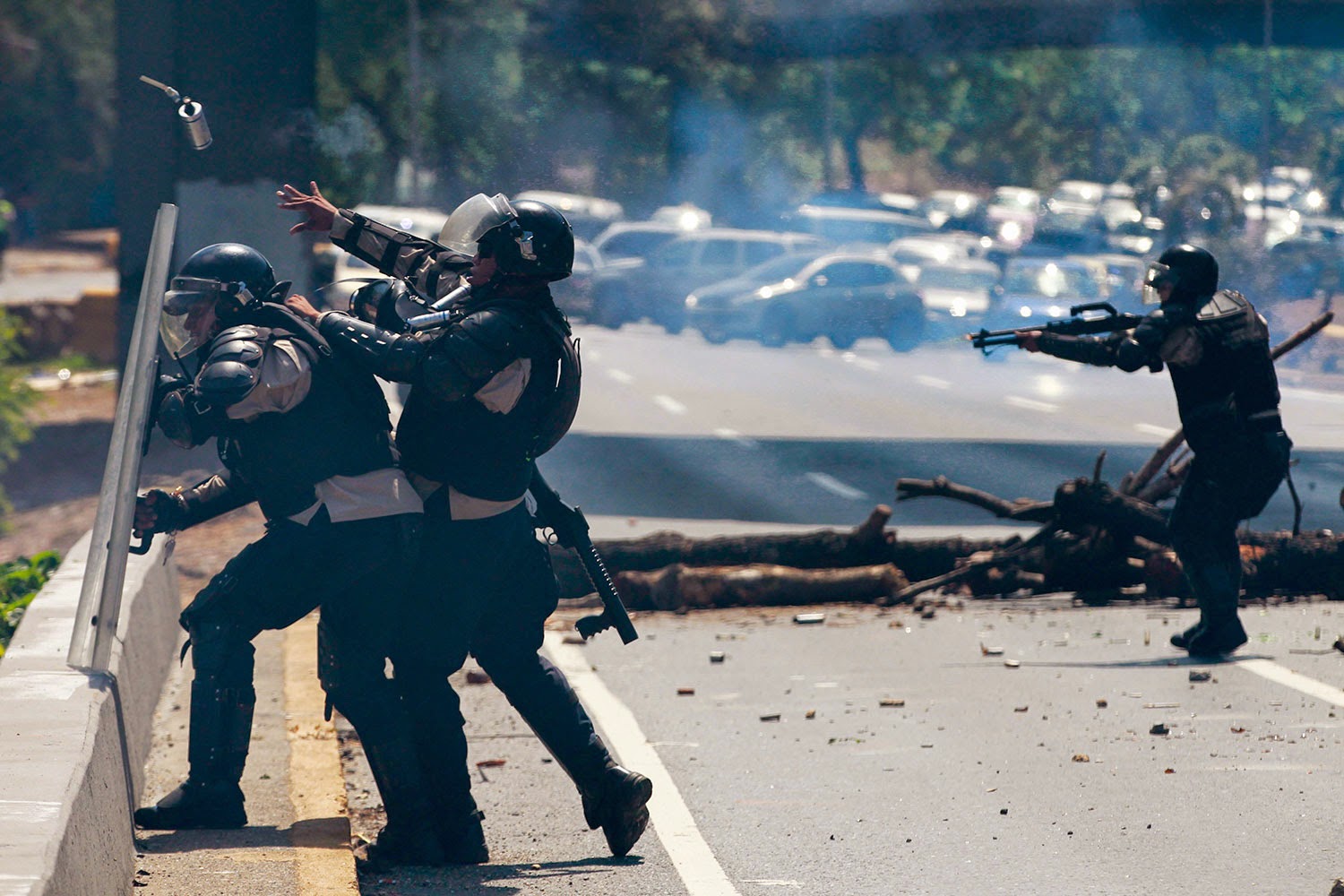
This past Wednesday, police in Venezuela detained at least 80 demonstrators who were
demanding the release of those arrested in recent anti-government
protests. According to BBC: "Wednesday's march was called by university students to demand the
release of more than 200 people who were detained after security forces
broke up protest camps last week. The government said the camps were being used as bases to
launch "violent attacks" and to hide "drugs, weapons, explosives and
mortars".
'No proof.' But a university student at the march, Alex Gomez, rejected
the accusations, saying "there was never a problem due to drugs,
weapons, or alcohol". "We are demanding that they show us the reasons why they arrested them," he told the Associated Press news agency". Read full article in the BBC.
Here's what the AFP says about the incident: "The students, who were marching to demand the release of protesters
arrested in recent days, massed in the east of the capital but the
demonstration quickly became violent when they targeted the Tourism
Ministry and riot police intervened. They detained around 80 people, Manuel Quevedo, commander of the National Guard regiment in Caracas, told AFP. Last week more than 200 people were arrested in police raids on
encampments of protesters in Caracas. Most have since been freed. "Fewer and fewer people are heeding protest calls. Intimidation has
succeeded," one of the young marchers told AFP Wednesday, requesting
anonymity after a previous arrest.
This is the report of Amnesty International about what happened the 14th of May in Caracas: On 14 May security forces in Caracas detained at least 100 people involved in ongoing anti-government demonstrations. They are at risk of torture or other ill-treatment and their right to due process is at risk. Read full report (in English, Spanish or French) in Amnesty International, and have a look at the photos in their Facebook profile here.
Finally here you can have a look at the propaganda in official texts books distributed by the Ministery of Education, aimed to be used by high-school students, promoting key figures of the government, among them Hugo Chávez "Supreme Commander" or "Eternal President", cultural icons of chavism and government projects. Have a look at the photos (including the cover with the word "English" with a massive accent in the "i") in El Universal (link in Spanish).
Hello everyone, hope you're having a nice day. This is today's edition: the most recent court decision and a summary of the Venezuelan situation for the outsider's eye in our News section; in Science, we feature a great Spotlight by Lance Ulanoff (via Mashable) on the virtual reality renaissance; in our Design, Business & Innovation section everything you think you know about the Internet is wrong; Sadie Smith and the story of our beloved Moleskines in our Culture section; In Dog We Trust shares interesting articles about adopted squirrels and introduce us to Cesar Frenchie; and in Our Weekly Procrastination section we invite you to visit the wonderful Chris Marker's exhibition at the Whitechapel Gallery.
Happy Sunday and happy reading!
NEWS
Photo: Juan Barreto via AFP.
Firstly, the most important thing that happened in Venezuela this past week was that the Constitutional Court determinedthat the rightto peaceful demonstration, established on the Article68 ofthe Venezuelan Constitution,"is not an absolute right" as guaranteesto life and health. We kind of already knew that, but now, it's legal. Read resolution here (link in Spanish).
This is how people reacted, explained by AFP: "Several thousand people took to the streets of Caracas and other
Venezuelan cities Saturday to protest education reform plans and
restrictions on the right to demonstrate". Read full article here.
Photo via The Objective / El Subjetivo.
And just in case any of the readers of this little procrastinator's newspaper still have any doubt of what type of government is the Venezuelan one, I translated a post wrote by Laureano Márquez in the blog The Objective (link in Spanish) because is a good attempt to explain Venezuela's situation to someone that doesn't live there or that hasn't been following the situation closely. Its oversimplified, but again, if someone wants more information I can gladly provide it or you can check the posts tagged #sosvenezuela and find loads of articles. Please excuse my imperfect English specially with technical/legal terms (any correction or suggestion will be appreciated), hope is useful for you to understand Venezuela a little bit more.
"To explain what happens in Venezuela to someone that has not live there the past 15 years is really complex, because, as the proverb goes: God is in the details. Formally, Venezuela is seen as a solid nation with a solid democratic system that contemplates periodic elections. That is appearance, of course, details tell a whole other story:
• The division of powers is non-existent. All are subdued to one, the executive, leaving the citizens in a state of legal defenselessness.
• Constant practiceofpolitical intolerancetodissenting; opposition members are qualified systematically as "traitors", "fascists", "conspirators" (without ever giving any proofs), which translates in political exclusion and limitationsonthe exercise ofcitizens' rights.
• Crackdown on peaceful protestors; violations to Human Rights, torture, prison, illegal dismissal of congressman and mayors rightfully elected, opposition leaders jailed, etc.
• Lack of a reliable electoral system, as 4 of the 5 counselors are openly pro-government. Absence of an auditable elections record, evident irregularities like double voters, intimidation of voters, electoral centers with results of100% of votes in favorof the Government option, harassment of opposition election witnesses, and a more than evident opportunism in election campaigns with blatant and illegal use of the State's resources.
Also, there is an economic crisis of unpredictable consequences, due to politics like:
• Expropriationsof companies thatin state handsbecamecorruptand unproductive.
•
Exchange controlsthat preventfreeaccess to foreign exchange. Governmental controlin this area hasgenerateda recordcorruption, the figure is close to US$ 30,000,000.
• Highinflation.Inthe official figures, which some experts sayaremade up,itis closeto 57%.
•
Shortage of basic goods and food, had force the Government to establish a ration card. Queues 5 and 6 hours to get oil, milk or corn flour have become every Venezuelan's reality.
All these led to the protests that started back in February and haven't stopped. The student movementhasstagedpeaceful protestsin reaction tothe violence and insecurityin the country, that leaves thousands of deathseach year, kidnappings and robberies.The governmentreactedviolentlyrepressingthe protesters and incitingparamilitary groupsto act; more than 40victimsin two monthsand a total oftortured, arrested and processed students never seen inVenezuelasincethe mostcruel of our dictatorships.
Venezuela's serious governance crisis, not only have roots in the economy, deficient health system (there are no medicines), education, food, but also in the alarminginsecurity that situates Venezuelaas the second mostviolentcountry in the world.
In this climate,a process ofdialogue betweengovernmentand sectors of theoppositionwas initiated.So far ithas generateda lot of expectations, but no concrete results.
Morning everyone! Hope you are enjoying your Easter holidays. In our news section we have one article about Narcissist in Chief, Valdimir Putin, and a couple of articles about Venezuela, mostly a little follow-up from last week "dialogue", not very useful responses from the government, but well, that's no surprise. Among the articles though, there is an interesting piece of Moisés Naím, this time in the Financial Times about the under-reported influence/control of Cuba over Venezuela. In our Science section Adrianne Lafrance introduce us to Kepler-186f, Earth's closest cousin, and Maria Konnikova talks about the science of yawning. In our Business section, some accurate descriptions of media jobs, and the darknet of drugs and guns, disturbing! And of course our Culture Section is devote to one of our favorite Latin American writers of all times: Gabriel García Marquez, el Gabo. Finally, in our lovely section In Dog We Trust you get to meet Rio Blue that belongs to one of my favorite breed of dogs: the Boston Terrier!
Happy 04/20 people, good Sunday and good reading!
NEWS
Narcissist in Chief. Joseph Burgo writes in The Atlantic about Vladimir Putin's narcissistic behavior. Some insights obviously can be extended to other more tropical messianic leaders, if you ask me. Here's a fragment of Burgo's piece: "Is it accurate to describe Putin as a narcissist in the clinical
sense of the word? Can an understanding of the psychological roots of
narcissism help us to gain deeper insight into the man and how we should
respond to his aggression, rather than using the label to deride him? Maybe." Read full article in The Atlantic. E.T.P. 11'
Venezuela students add Easter twist to dwindling protests. Venezuelan
students are marching barefoot, building crucifixes and planning to burn
effigies of President Nicolas Maduro to try and breathe new life into
their protest movement over Easter.
The religious-themed
demonstrations are the latest tactics in anti-government protests since
early February that have convulsed the South American OPEC nation and
led to 41 deaths. Read full article in Reuters. E.T.P. 3'
Cuba fed a president's fears and took over Venezuela. The enormous influence that Cuba has gained in Venezuela is one of the most underreported geopolitical developments of recent times. It is also one of the most improbable.
Venezuela is nine times bigger than Cuba, three times more populous,
and its economy four times larger. The country boasts the world’s
largest oil reserves. Yet critical functions of the Venezuelan state are
either overseen or directly controlled by Cuban officials.Read full article by Moisés Naín in Financial Times. E.T.P. 6'
Venezuela's military admit excesses during deadly protests. The military in Venezuela
has admitted it committed "some excesses" during weeks of political
unrest that have left more than 40 people dead. The military's strategic command chief, Vladimir Padrino,
said they were investigating 97 officers and police staff for "cruelty
and torture". Read full article in BBC. E.T.P. 3'
Venezuela rejects amnesty for jailed protests leaders. The Venezuelan government has dismissed calls by the opposition for an amnesty for jailed protest leaders. Government and opposition representatives met for a second
time on Tuesday to try to put an end to two months of anti-government
protests.
Following the meeting, Ramon Aveledo of the opposition MUD coalition said his proposal for an amnesty law had been rejected.Read full article in BBC. E.T.P. 5'
Last week Taiwan joined the wave of students protests around the world, as Venezuela enters the 8th continuous week of protests after facing another devaluation of its currency -while violence and repression stand still. These is what constitutes our News section. In Culture & Entertainment, the best sentences in fiction and non-fiction compiled by the editors at The American Scholar magazine; in Design, Business & Innovation, Facebook splurging billions to buy Oculus Rift made the headlines, as well as the success of the online language learning app Duolingo; In Dog We Trust share with us a way to watch, talk and play with your pet from your smartphone; and finally, in Our Weekly Procrastination, we have some photos from our visit to the Henri Cartier-Bresson exhibition at the Centre Pompidou, absolutely recommended!
Happy Sunday and happy reading!
NEWS
Photos via Quartz.
Last Sunday, Reuters reported the student's protests in Taiwan: "Hundreds of
demonstrators occupied part of Taiwan's government headquarters on
Sunday night in protest against a controversial trade pact with mainland
China.President Ma Ying-jeou says the pact with Taiwan's main export market is essential for the island's prosperity. However, the main opposition party says it could hurt small service companies, and many others are reluctant to let China expand its influence over a fiercely independent and democratic territory that China still sees as a renegade province." And Quartz published an interesting article about how to mainland China, Taiwan’s student protests prove that democracy doesn’t work. Read full article here. E.T.P. 3'
Venezuela's situation keeps going nowhere but down. This past week there was an 'undercover' devaluation. An article in Bloomberg describe it this way: "Venezuela allowed the bolivar to
weaken 88 percent on a new currency market after loosening
controls, a move to increase dollar supplies needed to alleviate
a record shortage of imports including medicine, food and toilet
paper. The bolivar was sold for an average 51.86 bolivars per
dollar yesterday on the new system, the central bank said on its
website. The government’s official exchange rate used to import
medicine and food is 6.3 bolivars per dollar and a secondary
dollar auction system last sold greenbacks at 10.8 bolivars." Read another article in Reuters.
Also Tal Cual, a Venezuelan newspaper published a very interesting article called "Gobierno Malandro" (Thug Government) compiling several intersting comments in international media that contest the 'official' government version about what is happening in Venezuela. Is absolutely worth reading, and if you don't read Spanish, these are the articles quoted by Tal Cual:
Vice also offers a good summary of some of the things that happened last week: "Ever since anti-government protesters started pouring into Venezuela’s streets
almost two months ago, President Nicolas Maduro has accused them of
trying incite a US-backed coup like the one in 2002 that briefly deposed
his predecessor, Hugo Chavez. He’s been doing so with such regularity,
you’d think he was inviting the prospect. Well, it appears he’s finally gotten his wish. The
Venezuelan government has arrested three air force generals it accuses
of planning to oust Maduro with the help of opposition leaders. The
alleged plot was reportedly discovered after concerned officers alerted
authorities to the “conspiracy.” The generals have not yet been named, nor has any evidence been presented to the public." Read full article in VICE.
Other articles:
Este reportaje en español de el diario El País vale una leída:
"Cuba recibe por cada cooperante que envía a #Venezuela más de 8.000 euros al mes. Al trabajador solo le llegan unos 200." "Los médicos cubanos son enviados en carácter de esclavitud moderna”, dice la ONG Solidaridad Sin Fronteras.
***Updates:
AlJazeera: Violent Protests in Venezuela Continue: Protesters fought with police in the Venezuelan capital Caracas in the
latest round of clashes since anti-government protests began in
February. The demonstrators, who included many students, were angry at a
supreme court decision to remove congresswoman, Maria Corina Machado,
from office. Many protesters were detained during the violence, which
saw police fire tear gas and rubber bullets. Al Jazeera's Mariana
Sanchez reports from Caracas. (Added Apr, 03)
Informe de Amnistía Internacional sobre Venezuela: Los derechos humanos en riesgo en medio de protestas,
documenta denuncias de violaciones y abusos a los derechos humanos
cometidos en el contexto de las masivas manifestaciones que tuvieron
lugar desde comienzos de febrero. Hasta el momento, 37 personas han perdido la vida y más de 550 han
resultado heridas, al menos 120 tras el uso de armas de fuego. Según
datos publicados por la Fiscalía General el 27 de Marzo, 2,157 personas
fueron detenidas durante las protestas. De acuerdo a información recibida por Amnistía Internacional, las fuerzas de seguridad del país han recurrido al uso de fuerza excesiva, incluyendo armas de fuego, y hasta han torturado a manifestantes. El informe también documenta abusos a los derechos humanos cometidos por grupos progubernamentales, manifestantes e individuos no identificados. Descargar aquí. (Added Apr, 01)
This week has been really tough, but only if you've been paying attention. I've realized how easy is to go through life paying little to no attention to what happens around you unless someone burst into flames right next to you on the Tube. Not that I didn't know that, but sometimes these things become more painfully evident.
Venezuela had a week-long nightmare, as well as Ukraine. I notice that most of the people that visited the blog during the last week were from Ukraine (second after the US), and I felt bad about not having anything about them in the News section. Is true that they have a lot of attention of the media, that Europe is not indifferent to what is happening with them (unlike Latin America to what is happening in Venezuela), and more important, to be perfectly honest I don't know much about Ukraine, other than the things I could have read in the newspapers, and I know, how infuriating and frustrating it is to read inaccurate information about your reality, interpreted by people trying to accommodate it to their ideologies and their structures, making no effort at all to really understand.
The News section this week features Ukraine including a couple of links that I think were helpful for me to understand what is happening and a lot of photos. And of course, Venezuela and its ongoing protests that as violence and censorship escalates are getting more attention from international media. Finally.
The rest of the edition is short, but sweet, as they say. Please have a look at the Culture section that includes one really sexy film list by the BFI; The Guardian's review of the new Henri Cartier-Bresson exhibition in the Pompidou, and little more on Spike Jonze's Her. In Design, Business and Innovation there are articles about storytelling, Google Glass and the Toy Fair. And finally in our Science section is cyborg time.
Happy Sunday and happy reading.
NEWS
Kiev's Independent Square Before and After. Via The Atlantic.
Anti-government demonstrators remain in Independence square, on February 22, 2014. (Jeff J Mitchell/Getty Images) via The Atlantic.
The images that came from Kiev's violent clashes this week were devastating. By the time I'm writing this the situation is as follows: the government had agreed a pact to call early presidential elections, the quick formation of a coalition government with the opposition, and ruling out a state of emergency, but people remained on the streets, as presidential election promise was not enough to satisfy the protesters after the bloody clashes leave dozens dead. Ukraine's parliament voted to remove Yanukovych from office and he denounces the actions as a "coup". His whereabouts are unclear. The barricades surrounding Independent square are still in place; the leaders of the paramilitary police who fought protesters have appeared on television to say they are “with the people”; the opposition leaders in the streets surrounding the presidential building, that used to be under custody of the police, say that Yanukovych is not coming back in there. Only the new president will step in. Have a look at the links below, and if you're from Ukraine and you want to share something with us, please do so.
The Economist: Ukraine's New Dawn. Shots called, now what? "As the outside world was digesting the deal between the Ukrainian regime
and the protesters, and the unexpectedly helpful role of Russia in the
European Union's mediation efforts, everything changed. President Viktor
Yanukovych fled the capital, Kiev and protesters who only hours earlier
had been dodging sniper bullets found themselves guarding the
presidential palace."
Photo from the 18F, this is the opposition demonstration in Caracas,
I love this image. Reuters via Buzzfeed.
Photo: Manifestations in London. The Procrastinator (some) Times.
Yesterday there were yet more manifestations in Venezuela, and also more repression. Táchira state is been fighting really tough and in isolation because the government shut down the Internet in the area, as well as electricity and water in some sectors, while threatening them in national TV with taking stronger measures. Also Venezuelans outside the country called for demonstrations around the world to show their support to the students, and claim for more international media attention so the world can find out about the clear violation to human rights that the Venezuelan government keeps inflicting on their people.
The Guardian: Venezuela's poor join protest as turmoil grips Chávez's revolution. "...As demonstrations sweep several major cities, even the people of Petare
have taken to the streets to protest again surging inflation, alarming
murder rates and shortages of essential commodities."
Gawker: How Venezuela became a "warzone"?Even as the near-apocalyptic imagery of Ukraine's violent protests have
captured the top of the news, Venezuelan cities have gone from dangerous
to "warzone" overnight. Boing Boing: Venezuela: 15 Years of Solitude. "The governments of Hugo Chavez and Nicolas Maduro, amongst the most
corrupt and inefficient in the world. . . Very few authors (Will Dobson, Michael Penfold, Javier Corrales)
have studied Chavez as a new form of authoritarianism. Public opinion
in general, for the 14 years of the Chavez regime, viewed him as a
modern-day Robin Hood."
The answer to Channel 4, is yes. Venezuela is burning while the world
watches Ukraine, Sochi, memes about Whatsapp and the girl scout that
sold 177 boxes of cookies.
Caracas Chronicles: The other side of communication hegemony. "Just remember, guys, it’s the opposition who practice “media terrorism.” And Eurasia has always been at war with Oceania." (Added Monday 24F) The Telegraph: Venezuela, the lefts favourite socialist paradise is sliding into poverty and dictatorship. ¨How is Venezuela doing? Well, tens of thousands of protesters are in the streets, the army's been sent to crush revolt, an opposition leader has been arrested and supporters of the government just shot dead a former beauty queen. It's going to hell in a handcart, that's how it's doing."(Added Monday 24F)
The Daily Beast: Venezuela's Useful Idiots. "Defenders
of the Venezuelan regime would never allow the White House to arrest
opposition leaders and shut down unfriendly media outlets. So why the
double standard?" (Added Tuesday 25F)
The Huffington Post: Venezuela and the hypocrisy of the international left. "As students and the middle class protest for almost two weeks in the
streets of Venezuela, the international left remain silent. Why is this
wide swath of Venezuelan society protesting? Because of meddling from
the United States in preparation of a fascist coup, says Venezuelan
President Nicolás Maduro. Certainly lines borrowed from the Cuban/Soviet
handbook." (Added Tuesday 25F)
BBC: Venezuelans Stop Traffic in Anti-government Protests The BBC invite people who has witness the protests to email them at haveyoursay@bbc.co.uk adding 'Venezuela' in the subject heading. to send pictures and videos to yourpics@bbc.co.uk or text them to 61124 (UK) or +44 7624 800 100 (International). If you have a large fil you can upload it in the website. (Added Tuesday 25F)
Fast Company: Why Venezuela is exploding, explained in simple charts. Even as political arrests intensify and injuries and deaths mount, Venezuelans remain on the street, making their voices heard. The reasons for their persistence are clear from Gallup's 2013 World Poll data - they see their lives and the economy getting worse, and they feel less secure than ever in their own neighborhoods. (Added Thursday 27F)
El País: La soledad de los estudiantes venezolanos. Mientras el país se encamina hacia una dictadura, en Latinoamérica
hay un apoyo al chavismo por parte de la izquierda derivado, en el
fondo, del prestigio menguado pero extrañamente vivo de la Revolución
cubana. (Added Friday 28F)
Esquire: Before and after: Venezuela on Instagram. 30 photographs of how normal life changed in a matter of days when
the people stood up to what they feel is an oppressive regime. (Added Friday 28F)
First day of December! So many clichés to say about time and the future. I won't say any just because I promised last month not to do it. But I'm dying here people. In this week's edition of The Procrastinator we have an article about Bitcoin for everyone that, like me, still don't understand Bitcoin very much. Interesting articles about Design Thinking, GhostFood and about amazing/crazy plans for the Moon. In Dog We Trust introduce us to Eiconne and Pootle. And finally, cool projects in our Culture & Entertainment section; some lovely like Yoni Lefévre's Grey Power, some bonkers like James Franco & Seth Rogen's parody video, amazing example of massive procrastination.
Happy Sunday and happy reading! x
NEWS
Photo via The Economist.
I have to confess that I don't truly understand Bitcoin yet. I know. I'm making an effort here. This article helped me understand a bit more because it explains how it all began, its popularity and controversy, and I love how it starts: "ALL currencies involve some measure of consensual hallucination, but
Bitcoin, a virtual monetary system, involves more than most. It is a
peer-to-peer currency with no central bank, based on digital tokens with
no intrinsic value. Rather than relying on confidence in a central
authority, it depends instead on a distributed system of trust, based on
a transaction ledger which is cryptographically verified and jointly
maintained by the currency’s users." Read full article in The Economist. E.T.P. 8'
Photo via The New Yorker.
Gregory Gause explains in The New Yorker why the deal between the United States and Iran scares Saudi Arabia. "After the five permanent members of the U.N. Security Council and
Germany concluded a preliminary agreement with Iran on Sunday, it did
not take long for regional critics of the deal to react. The Israeli
Prime Minister, Benjamin Netanyahu, blasted
the agreement as “a historic mistake.” Saudi Arabia, the other American
ally in the Middle East worried about an opening to Iran, took a
different approach, issuing a carefully worded statement that cautiously welcomed the deal." Read full article in The New Yorker. E.T.P.
This edition of The Procrastinator is sweet and short. Well, right after this words there's a photo of Cody Wilson, so maybe is just a short edition. While you are reading this we are preparing to go and share our Sunday here, if you're in London, you definitely should join. If not, you have really good articles to read: a couple of articles about JFK via VICE and El País, one very interesting and absolutely scary about the post-antibiotics world via Medium. Inspiration in film by Jonas Mekas via Dazed Digital, and Nymphomaniac's trailer, in our Culture & Entertainment section, is worth seen today because is [NSFW] and part of the Photoautomat section too (now you're intrigued, right?). We have Rita Fernández as guest writer sharing with us her weekly procrastination. And finally, La Guia del Perro's In Dog We Trust share with us some of her amazing tips and two adorable dogs: Ginny and Otter.
Happy Sunday and happy reading!
NEWS
Photo via VICE.
It has been a lot of articles written, photo galleries posted, and dusty conspiracy theories being polished lately about JFK in the 50th anniversary of his dead... and the beginning of his myth? Danny McDonald's article in VICE talks a bit about that, this is how it starts: "Seated behind his anchor’s desk, Edward R Murrow lights up a cigarette
while listening to John F Kennedy read a passage from American poet Alan
Seeger. It's one of the coolest interview snippets
in the history of American media. And that says a lot about what JFK
has become: an icon who once happened to be president. My generation
knows him as a really good-looking guy who married a really good-looking
woman, with whom he had really good-looking children, before he was
shot in the head while being driven through Dallas, Texas. Details of his presidency are, at best, vaguely understood, and mostly
we ignore his political legacy. Bay of Pigs? Don’t harsh the mellow, bro
– just look at that hair." Read full article here. E.T.P. 6' and if you speak Spanish you can also read this other interesting article called Los que vieron morir a JFK in El País. E.T.P. 10'
Photo via The Independent.
Cody Wilson, the 25 years old man, driven by a libertarian philosophy and by the desire to put a gun in the hands of anyone who wants one, was named by Wired magazine as one of the world’s 15 most
dangerous people (below Bashar al-Assad but above Paula Broadwell) after he created a gun that can be downloaded and built
with a 3D printer. The online blueprint for his handgun – the Liberator –
has been downloaded 100,000 times since it was released in May. I am equally scared of Wilson and every single one of the 100.000 people that downloaded his files. Paul Peachy in the Independent writes about Wilson's visit to London and his new mission: to challenge the global financial system. Read full article here.
Photo: Maureen Drennan via The New Yorker.
Buzzkill. Now that marijuana is legal in a number of states, Patrick Radden Keefe
explores how Washington State discovered that is not easy to create an economy around it and its efforts to develop it
without turning too many of its citizens into potheads. Read this interesting article in The New Yorker. E.T.P 22'