EDITORIAL
This been another one of those weeks. Just when the international press started to forget about Venezuela, the government give them reasons not to. We feature news from The Economist, Mashable and El Universal, among others, and you can find the link to the Human Rights Watch report called "Punished for Protesting: Rights violations in Venezuela's Streets, Detention Centers and Justice System". The latest news about Boko Haram and the kidnapping of around 300 school girls in Nigeria can also be found in this section.
In our
Science section, an interesting article about having or not having sex with robots, that is the question. Celebrities in ads, a great language exchange program and plans of building a train between China and America in our
Design, Business & Innovation. In the
Culture & Entertainment section the Topless Pulp Fiction Appreciation Society takes off, Paul McInnes writes in The Guardian about Studio Ghibli after The Wind Rises and Semi Chellas interview Matthew Wiener for The Paris Review. Finally,
In Dog We Trust shares interesting links about bullying and happy dogs in Australia.
Also, today is Mother's Day in Venezuela and I want to send a big kiss to my mum, my granny, and to all my lovely friends with kids in Venezuela (and I think in the US too!). Hope you have an amazing Sunday.
To everyone else, happy Sunday and happy reading.
NEWS
This week the world kept demanding the freedom of around 300 school girls abducted by the extremist Islamic group Boko Haram, that
is fighting to overthrown Nigerian government to impose an Islamic state. This are the latest news.
According to The Guardian: "Nigerian security forces were aware that an armed convoy of
Boko Haram militants was approaching the town of Chibok almost four hours before the
extremists kidnapped 300 girls from a school in the town, Amnesty International said on Friday. The
human rights group claimed the military was warned an attack was
imminent but did not send reinforcements because of a lack of resources
and an unwillingness to engage with well-armed insurgents. Read full article in The Guardian. E.T.P. 7'
|
Al Jazeera reports: "Nigeria's president has said that his country will
win its "war on terror", despite another attack by Boko Haram fighters
in the northeast that reportedly killed hundreds. Read full reportage in Al Jazeera. E.T.P. 6'
And finally The Independent adds: "Intelligence sources believe girls kidnapped
from a school in Nigeria may have been split into four groups after they
were taken by militant Islamist group Boko Haram, making finding them an increasingly difficult task." Read full article in The Independent. E.T.P. 8' |
 |
| Photo: Carlos García Rawlins (Reuters) via Newsweek. |
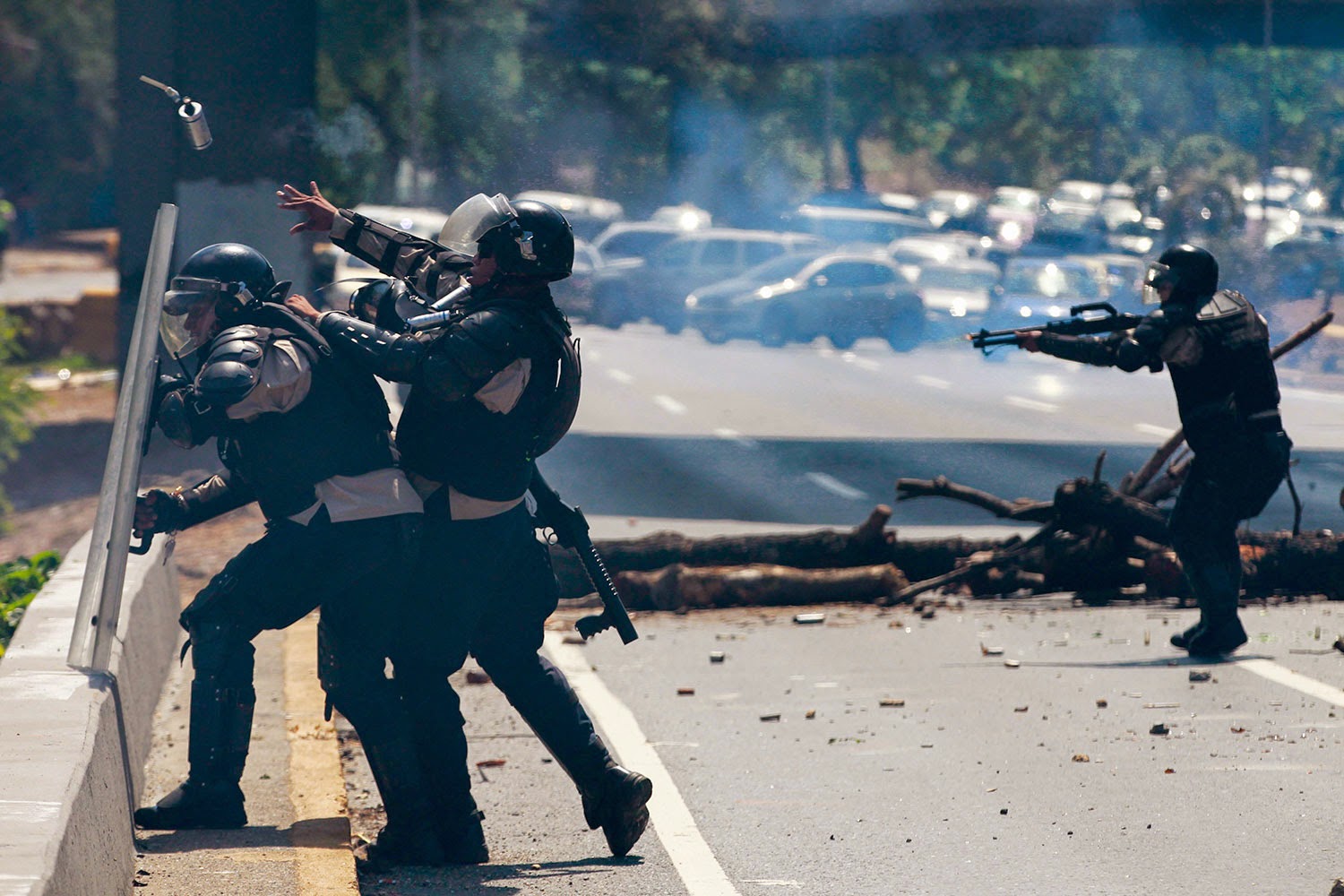
Earlier this week The Economist published an article about Human Rights violations in Venezuela that highlighting the findings of the
Human Rights Watch (HRW) report called "Punished for Protesting: Rights violations in Venezuela's Streets, Detention Centers and Justice System". The Economist article describe how late President Hugo Chávez's revolution took off the "pretty revolution" mask and started revealing its (at least to the world, we've always know) real face.
"Since Chávez’s death last year from cancer,
the pretty revolution’s make-up has begun to peel. His successor,
Nicolás Maduro, has none of the
comandante’s famous charisma,
and growth in oil income has stalled. Anger over food shortages and
uncontrolled violent crime spilled over in February into nationwide
protests. The government’s response has been a harsh crack-down that has
seen over 2,500 people detained so far. Human-rights groups say
excessive use of force, beatings and denial of due process have been
routine.
In the first detailed report on the subject by an international
body, released on May 5th, HRW accuses police and
national-guard members of “routinely” using unlawful force against
armed protesters . . . with the complicity
of prosecutors and judges, who both “turned a blind eye’ to human-rights
violations and deliberately hindered detainees’ access to their
families and lawyers."
 |
| Photo: Jorge Silva (Reuters) via El Universal. |
Almost to prove HRW right, the Venezuelan government, just days after another round of violent attacks to some Venezuelan
universities like the UCAB in Caracas and the Fermín Toro in Lara (
link in Spanish),
in a extreme (but not surprising) act of cowardice and abuse of power,
sent its security forces to dismantle four student camps across Caracas,
as Mashable says "in the wee hours of Thursday in coordinated raids
that ended
with the arrest of 243 students. It's one of the government's biggest
crackdowns on the student protests that have been sweeping the country
for more than two months."
Some people believe that the amount of students jailed in that operation
is bigger. And while the government congratulate its security forces
for putting in jail more than 200 students whose only "crime" was
protesting, there has been already 4860 people murdered in the first
four months of the year (
link in Spanish),
that is around 40 people everyday. To stop insecurity and violence
State's security forces are far less efficient, or maybe they had not
even been instructed to do so.
 |
| Chart via CATO.org (click to enlarge). |
Finally, to finish with the Venezuelan news of the week, the
CATO Foundation published the Misery Index ranking of 2013, "the misery index concept can be applied to any country where suitable
data exist. A misery index — a simple sum of inflation, lending rates,
and unemployment rates, minus year-on-year per capita GDP growth — is
used to construct a ranking for 89 countries." Venezuela, of course, holds the Top Spot with an index value of 79. 4. Although, Steve H. Hanke, the author of the article in Cato.org adds: "I estimate that
Venezuela’s annual implied inflation rate at the end of last year was
278%. That rate is almost five times higher than the official inflation
rate. If the annual implied inflation rate of 278% is used to calculate
Venezuela’s misery index, the index jumps from 79. 4 to 301, indicating
that Venezuela is in much worse shape than suggested by the official
data."
"The accompanying chart confirms Friedman’s observation. In Venezuela, 28% of basic products are not available."
Read more:
UN News Centre:
UN concerned at renewed violence, reported excessive use of force
El Universal:
Protests and repression after police dismantled students camps in Caracas
Mashable:
Venezuela Arrests 243 Students in Biggest Protests Crackdown
The Guardian:
Venezuelan Police Break Up Four Protests Camps
Prodavinci:
¿Qué fue lo que pasó en los campamentos de libertad de Chacao y Las Mercedes?