Showing posts with label the new yorker. Show all posts

Sunday, 29 March 2015

CULTURE & ENTERTAINMENT: Björk at MoMA, disappointing & embarrasing

Image via The New Yorker.


Having read only negative critics and reviews about the Björk exhibition at MoMA I feel that I have to post them here. Have any of our readers had the (bad) luck of visiting the exhibition? I would love to hear from you! Meanwhile, here's a fragment of the Prospero article in The Economist: "As a subject, Bjork is indeed worthy of formal scrutiny. She has spent decades crafting music that transcends genres. Her compositions are full of surprises, mixing techno beats with string arrangements, layering bells, beeps and purrs of wildlife. An avid collaborator, she has worked with many film-makers, fashion designers, producers and other artists, reliably coaxing out some of their best work. Then there is that voice—high, strong, clear, sometimes girlish, always unmistakable. No one sounds like Bjork. With this show, several years in the making, MoMA could have set a new template for a multimedia museum experience, blending music and video, text and artefacts. This retrospective could have mapped out Bjork’s creative process, placing her prodigious talent in some kind of context. Oh, this show might have done so many things. Alas, the only thing it reliably does is waste people’s time." Read full article in The Economist. E.T.P. 3'

The New Yorker's Peter Schjeldahl published an article on the same lines of The Economist one: MoMA's embarrasing crush with Björk. " rare consensus of critics has greeted the Museum of Modern Art’s show “Björk,” which is centered in a two-floor pavilion, in the museum’s atrium, packed with audio and visual exhibits tracking the Icelander’s career. Weighing in early, Ben Davis of ArtNet News predicted “an immense Eyjafjallajökull-sized ash-plume of critical bile to appear over midtown any second now.” And sure enough: tick tock, boom. New York magazine’s Jerry Saltz adjudged the show “a discombobulated mess,” and Jason Farago, in the Guardian, called it a “fiasco” and, not to waffle, a “disaster.” Roberta Smith, in the Times, zeroed in the “ludicrously infantilizing and tedious” audio narration, by the Icelandic poet Sjón, that accompanies a viewer’s pavilion tour with treacly sentiments about the progress in life of “a girl.” “Insure that you experience this journey as thoroughly as possible,” the unctuous voice urges at the start. What follows confirms the general rule that whenever anything artistic is described as a “journey,” you can be pretty certain of going nowhere. . . And yet Björk is unscathed." I'm so intrigued by this exhibition. Read the article here. E.T.P.

Sunday, 25 January 2015

NEWS: A Very Argentinian Mistery


Photo via The New Yorker


John Lee Anderson writes  in The New York Times "A Very Argentinian Mistery" a brief chronicle about the -indeed very Argentinian- murder of Alberto Nisman: "On Sunday, January 18th, Natalio Alberto Nisman, a fifty-one-year-old federal prosecutor, was found shot dead inside his locked Buenos Aires apartment. There was a gun nearby, and a bullet wound to his head. Nisman had spent the past decade investigating Argentina’s worst-ever terrorist attack—the 1994 car bombing of a Jewish center in Buenos Aires, the Asociación Mutual Israelita Argentina, or AMIA, which killed eighty-five people. A few days earlier, he had released a report alleging that President Cristina Fernández de Kirchner and Foreign Minister Héctor Timerman had engaged in a massive cover-up of Iran’s role in the AMIA case in exchange for trade concessions. In order to investigate the case, Nisman also repudiated a 2013 memorandum of understanding signed by Timerman and his Iranian counterpart. He had been due to present evidence in the National Congress on Monday, the day after his body was discovered." Read full article in The New Yorker. E.T.P. 4'

Jonathan Gilbert and Simon Romero also report the puzzling death of Nisman in The New York Times. "Police sentries guarded the federal prosecutor’s luxury high-rise building. His door on the 13th floor had been locked from the inside, and a gun with a spent cartridge was found on the floor near his body. There was no suicide note.Just one day earlier, on Saturday, the prosecutor, Alberto Nisman, said, “I might get out of this dead.” Read full article in The New York Times. E.T.P. 6'

Sunday, 17 August 2014

CULTURE & ENTERTAINMENT


Images: Peter Mendelsund book jackets for The Trial, Hopscotch and of course Cover.


I 'discovered' book jacket designer and Knopf's Associate Art Director, Peter Mendelsund about 5  years ago when I came across the wonderful design work he did for Kafka books and his very interesting reflexions on what make Kafka, Kafka. I found everything extraordinary, honest and refreshing, and being a Kafka fan myself I entered in contact with him, he turned out to be a really nice person and a super interesting character. Back then I started following his blog, where he shows not only his finished works but also a little bit of his process and his thoughts on design and books. One of his most famous covers are the ones he did for Stieg Larsson's The Girl with the Dragon Tattoo trilogy, one of the ones I love most is the one he did for Rayuela, the beautiful English edition I own (shown above).

This past week I discovered that now he is publishing two books of his own (two!). One is Cover a full color collection of his design work of the past eleven years, that includes a little bit of writing, as in his blog, "as well as essays from some of the writers and designers I’ve been fortunate enough to know, and/or work for and with over this short span of time" -says Mendelsund. The second book is an exploration into the phenomenology of reading What We See When We Read, a remarkable work of nonfiction where Mendelsund "combines his profession, as an award-winning designer; his first career, as a classically trained pianist; and his first love, literature—he considers himself first and foremost as a reader—into what is sure to be one of the most provocative and unusual investigations into how we understand the act of reading," according to the Amazon summary (that sadly has no author specified). 

Several articles appeared about Mendelsund's books, I chose two: one nice interview in LA Times (E.T.P. 5') and a great Q&A about the utility of book covers in the digital world in Slate (E.T.P. 3'). Go ahead and find out more about Peter Mendelsund nice work, and if you read his books, please let me know so we can discuss them! (WWSWWR is due to be released in the UK in September 10th).

Photo via the Badass Digest.


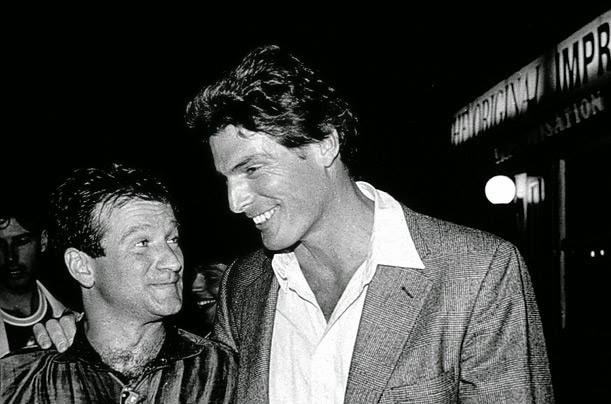
We are as deeply shocked and sad as everyone else with Robin Williams' dead. Here are some links with the best homages from the Internet, including five in-depth interviews compiled by Long Reads. Robin William's greatest lesser-known roles, compiled by Dazed Magazine (including a clip from one of my favorites: The Fisher King). A heart-warming article by Sarah Larson in The New Yorker called Robin Williams: The Best Weirdo. And finally, a piece in The Guardian by Dean Burnett on why we should not call suicide a 'selfish' act: "News of Robin Williams’s death due to apparent suicide, said to be a result of suffering severe depression, is terribly sad. But to say taking your own life because of such an illness is a ‘selfish’ act does nothing but insult the deceased, potentially cause more harm and reveal a staggering ignorance of mental health problems."

Also, the photo above was taken from a FB status of the Badass Digest, this little story can be read as  the photo caption:  

"When Christopher Reeve was in the hospital, awaiting a back surgery that had a fifty/fifty chance of killing him, a man burst into his room. He was wearing surgical scrubs, talking in a Russian accent, and said he was there to give a rectal exam. It was Robin Williams; the two men had been roommates together at Juilliard. Later Reeve said of his life-long friend:

“For the first time since the accident, I laughed. My old friend had helped me know that somehow I was going to be okay.”

That's sort of what Robin Williams did for all of us."

Sunday, 3 August 2014

The Procrastinator (some) Times Sunday 03 of August


EDITORIAL

It's August. I have not done the OMG-time-flies-so-fast routine in a lot of time so I think I'm entitled to one now. In August. OMG.

This edition is the first one of the second year of The Procrastinator (OMG), and we are starting with a new section named ABC, written by our great collaborator: Caroline Truyol. To describe the section I'll just quote Caroline: "The ABC for artists, books, and celebrities to fight against my name illiteracy through writing and creating an aide-memoire with emojis (inspired by the german game 'Stadt-Land-Fluss')." It couldn't be more clear, right?

In our News section a devastating chronicle by Richard Preston in The New Yorker describing the wake of the Ebola outbreak in Sierra Leone. Also a couple of articles about the Tower of David mass eviction in Caracas, Venezuela. In our Design, Business & Innovation section, H.R. Hennessy share his thoughts on how we are being dragged towards a tech-utopia that nobody wants, and to accompany our new section a mini test to find out how fluent are you in 'emoji'. Our Culture & Entertainment section is packed with goodies: Dazed Magazine's summer project: State of Independence curated by Kenneth Goldsmith, BFI's list of the best documentary films, and 'Emoji Among Us'. Yes, this is an edition particularly filled with emojis, I should have written all the editorial with them. In Our weekly Procrastination we talk about the wonders of the Magritte Museum in Brussels where we went a week ago. And finally, In Dog We Trust introduce us to Franklin the Frenchie, whilst the video of the week show us how dogs react to humans barking.

Happy August, happy Sunday and happy reading!


NEWS

Graphic via Quartz.


Richard Preston, author of “The Hot Zone,” describes the tragic wake of the latest Ebola outbreak in West Africa. "This spring in West Africa, a muttering emergence of the Zaire species of Ebola virus turned explosive. As of this writing, more than thirteen hundred cases of Ebola-virus disease have been officially reported in Guinea, Sierra Leone, and Liberia. The virus is spreading, uncontrolled, in widening chains of infection, which include cities—something never seen before. In Liberia, parts of the medical system have effectively collapsed. Some hospitals and clinics have been abandoned, while others have become choked with Ebola patients. The hospitals of Monrovia, the capital of Liberia, are full of Ebola patients and are turning away new patients, including women in childbirth. American Ebola experts in Monrovia are hearing reports that infected bodies are being left in the streets: the outbreak is beginning to assume a medieval character. People sick with Ebola are leaving Monrovia and going into the countryside to search for village faith healers, or to stay with relatives. In Sierra Leone, in the town of Kenema, eighteen doctors and nurses who had been working in the Lassa/Ebola ward have contracted Ebola, and at least five have died. They had been working in biological-hazard suits, yet they got sick anyway. People are wondering if the virus could spread to Europe or the United States, but the more immediate question is whether it could infect a whole lot more people in Africa." Read full article in The New Yorker. E.T.P. 3'

**UPDATE (Friday 8th August)**

WHO declares Ebola epidemic a global emergency. "The World Health Organisation on Friday declared the killer Ebola epidemic ravaging parts of west Africa an international health emergency and appealed for global aid to help afflicted countries. The WHO move comes as US health authorities admitted on Thursday that Ebola's spread beyond west Africa was "inevitable", and after medical charity Doctors Without Borders (MSF) warned that the deadly virus was now "out of control" with more than 60 outbreak hotspots. 
The scientists who discovered the virus in 1976 have called for an experimental drug being used on two infected Americans to also be made available for African victims. One of the three, Peter Piot, director of the London School of Hygiene and Tropical Medicine, said "African countries should have the same opportunity" to use ZMapp, which is made by US company Mapp Pharmaceuticals."

Read full article in Yahoo. E.T.P. 3'


You can also read:

Here are the 35 countries one flight away from Ebola-affected countries. Via Quartz. E.T.P. 6'

Ebola crisis: Virus spreading too fast, says WHO. Via BBC. E.T.P. 3'

US Ebola victim arrives at Emory University hospital in Atlanta. Via The Guardian. E.T.P. 4'


The skyscraper known as the "Tower of David" is seen in Caracas January 31, 2014. Photo: Jorge Silva via Reuters.

View of the Tower of David. Photo: Elyxandro Cegarra via Les Inrocks.

La Torre de David (Tower of David), the world's higher slum situated in downtown Caracas, Venezuela, home to more than 3000 people that invaded the property is finally being vacated. Some have a very romantic vision of that building as a community that emerged in the ruins of the capitalism, others like the Urban Think-Tank architectural agency praise it as a new model of vertical circulation. I think that you have to be very foreign or very cynic to be able to romanticize the tower. My very own personal mini-opinion is that is a just a massive symbol of the country's decadence that incredibly continues to accurately represent Venezuela's government, as the main reason for emptying the tower is believed to be because (among some other things) it was sold to China.

Reuters's article begins like this: "Venezuelan soldiers and officials began moving hundreds of families on Tuesday out of a half-built 45-story skyscraper that dominates the Caracas skyline and is thought to be the world's tallest slum". E.T.P. 3'

Les Inrocks article, like this: "This is the end of what has become a myth. On Tuesday, the skeleton of the Tower of David, known to be the highest squat in the world, down from its 45 floors, began to empty. Residents carry boxes and mattresses in front of journalists. They will be relocated by the government in new apartments. The evacuation could last several months. According to the last census, 1,740 families lived there, or at least 3,000 people, perhaps 5,000." Read the rest of the article in Les Inrocks (in French). E.T.P 8'


Sunday, 20 July 2014

The Procrastinator (some) Times Sunday 20th of July Edition


EDITORIAL

Dear friends, this is a very special edition for us, because is the Anniversary Edition (insert 'fiesta' emojis here). Yes, tomorrow is our birthday! A year has passed and we've come a long way (if you don't believe me, have a look at the First Edition.) Thanks to all the contributors, random collaborators, thank you for your feedback, for following us on Twitter, for sharing our articles, for letting us know that you enjoy and procrastinate by reading this little newspaper-ish edited with love for you.

This Anniversary Edition is also the official beginning of the summer in the Procrastinator HQ's (you know how it is, we do things in our own time), and that means that during the summer, the editions of the Procrastinator will be fortnightly and not weekly.

News about the situation in Gaza; about France and the elephant in the room: the race talk; and about London, who apparently is going to be the city most visited in the world in 2014 (hope that means you are coming to visit me!) In Science & Technology, flying cars can be real in just two years! In Design, Business & Innovation, explore the science of cool via Fast Company; and of course, in this edition we have to have an article about Grumpy Cat... or well, to be precise, Grumpy Cat's human. In Culture & Entertainment, Maria Konnikova on how to be a better online reader (very interesting!); George Clooney demonstrates he is monster-proof in his battle against the Daily Mail; also, you can brush up on your French with a nice flow-chart. In Dog We Trust celebrates with a summery edition, read it if you want to find out if animals have sense of humor, and also to have a look at the lovely dogs of the Instagram of the week because they are the best. Germán, prepared a very beautiful Sunday (Some) Times cartoon, I personally love it. Finally, one Special Section that we call Written Procrastination, from our lovely contributor Kerilyn Tacconi who send us for this edition a nice essay called Parallel Utopia, where she explores the possibility of escaping temporarily by not being where one is supposed to be. This is very close to the concept of procrastination as a mini-act of rebellion championed by David d'Equainville, creator of the Procrastination day.

Hope you enjoy our Anniversary Edition and get ready to celebrate tomorrow with us!

Happy Sunday, happy reading, happy summer, and if you STILL haven't done so, follow us on Twitter.


NEWS

Photo by Maha Shawan taken in Bit Hanon, Southern Gaza on Sunday July 13th  via The Huffington Post.
Taken on Sunday in Bit Hanon in southern Gaza, it shows a little boy outside what remains of his home. The bittersweet picture shows despite the destruction around him, something as simple as a balloon is still able to bring a smile to his face.

Seumus Milne in The Guardian thinks that the idea that Israel is defending itself from unprovoked attacks is absurd and that certainly occupied people have the right to resist: "For the third time in five years, the world’s fourth largest military power has launched a full-scale armed onslaught on one of its most deprived and overcrowded territories. Since Israel’s bombardment of the Gaza Strip began, just over a week ago, more than 200 Palestinians have been killed. Nearly 80% of the dead are civilians, over 20% of them children. Around 1,400 have been wounded and 1,255 Palestinian homes destroyed. So far, Palestinian fire has killed one Israeli on the other side of the barrier that makes blockaded Gaza the world’s largest open-air prison." Read full article in The Guardian. E.T.P. 5'

Bernard Avishai writes in The New Yorker: "We may think we have been here before, but we haven’t. The images of escalation are the same: exhaust tracing through Israeli skies; Gazans frantically picking through rubble; Israelis glued to their televisions, reduced to observers of spectacle, some poised to run for shelter but most affecting readiness, protected by rocket science and probability, fascinated by the deadpan proficiency of military officials whose mission may confuse them but to whom they suppose they owe their lives." read full article in The New Yorker. E.T.P. 6'

Thousands of people have marched through central London to call for an end to Israel's ground campaign and air strikes in Gaza. Protesters marched from Downing Street to the Israeli embassy in Kensington. A police blockade stopped them from gaining access. Whitehall, Trafalgar Square, Piccadilly and Hyde Park Corner were closed. Before the event up to 15,000 people were expected to attend. Read full article in the BBC. E.T.P. 2'


Photo via The New Yorker.

Since I moved to London, the most multi-cultural city I've ever lived in, I started filling legal forms that asked for my race. Surprisingly (or maybe not), I don't fit into any of the UK default race descriptors, and I end up ticking the less friendly of all: "other mixed background". That's why it surprised me discovering that the French don't gather data about race. This very same fact makes Alexander Stille ask in The New Yorker: Can the French talk about race? "France, with its revolutionary, republican spirit of egalité, likes to think of itself as a color-blind society, steadfastly refusing, for example, to measure race, ethnicity, or religion in its censuses. And yet France is, undeniably, a multicultural, multi-ethnic, and multiracial society, and has been at least since the nineteen-fifties, when large waves of immigrants began arriving from its former colonies. It has significant problems of discrimination, and of racial and economic segmentation, but limited tools to measure or correct them. The obvious answer—to many American scholars and to some French ones—is to begin to gather better data." Read full article in The New Yorker. E.T.P. 3'


Photo via The Economist.


LONDON is likely to be the world's most-visited city this year, according to a forecast by Mastercard, a credit card company. It reckons that 18.7m foreign visitors will come to Britain's capital in 2014, not including those that use the city as a brief stop-over on the way to somewhere else. The firm thinks Bangkok, with 18.4m visitors, will be the second most popular, followed by Paris (15.6m), Singapore (12.5m) and Dubai (12m). Read full article in The Economist. E.T.P. 2' (And if you're planning to come and visit (me), hurry, you have exactly 3 months!)

CULTURE & ENTERTAINMENT


Illustration via The New Yorker.


Maria Konnikova writes in The New Yorker: "Soon after Maryanne Wolf published “Proust and the Squid,” a history of the science and the development of the reading brain from antiquity to the twenty-first century, she began to receive letters from readers. Hundreds of them. While the backgrounds of the writers varied, a theme began to emerge: the more reading moved online, the less students seemed to understand. There were the architects who wrote to her about students who relied so heavily on ready digital information that they were unprepared to address basic problems onsite. There were the neurosurgeons who worried about the “cut-and-paste chart mentality” that their students exhibited, missing crucial details because they failed to delve deeply enough into any one case. And there were, of course, the English teachers who lamented that no one wanted to read Henry James anymore. As the letters continued to pour in, Wolf experienced a growing realization: in the seven years it had taken her to research and write her account, reading had changed profoundly—and the ramifications could be felt far beyond English departments and libraries. She called the rude awakening her “Rip van Winkle moment,” and decided that it was important enough to warrant another book. What was going on with these students and professionals? Was the digital format to blame for their superficial approaches, or was something else at work?" Read full article in The New Yorker. E.T.P. 9'

Photo: Gearoge Clooney, via The New Yorker.


George Clooney, Monster-Proof. Lauren Collins writes an excellent piece in The New Yorker that will give more reasons to never read the Daily Mail again... if is the case that you still have that nasty little habit ;) Three great fragments of this excellent reading: "Until last week, when George Clooney excoriated the Daily Mail for fabricating a story about his future mother-in-law, the newspaper’s most prominent sworn enemy was Hugh Grant" . . . "The Mail is a machine for wasting reputations. Sometimes civilians are its fodder, “monstered” like so many recyclables that got thrown in with the garbage. The paper demonstrates particular efficiency and relish in shredding the character of celebrities" . . . "The Mail, like all bullies, has quieted down in the face of a fair fight. It doesn’t seem to have found even a mildly tawdry means to impugn Clooney’s motives, and the false story was not a triviality." Read full article in The New Yorker. E.T.P. 4'


Infographic (fragment) via LA Times.

If you're studying French, thinking of visiting Corsica this summer or if you just want to have a look at a nice infographic, our contributor Marie sent us this nice Bastille-Day flow chart to brush up our French a little. Allez! Have a look at the full chart in L.A. Times. E.T.P. 2'

Sunday, 6 July 2014

CULTURE & ENTERTAINMENT


Photo via The Paris Review.

Nicole Rudick in The Paris Review of all the articles featured in the printed edition of Nautilus Magazine, that she calls sharped and well-rounded, recommends Alisa Opar’s short piece in the Spring 2014 issue on procrastination, which we featured back in January, of course. "I’m writing this, you see, up against the deadline that Dan Piepenbring sets for us each week. I did the same thing last week. Though I spend all week knowing I’ll write a few lines on what I’ve been reading, I wait, without fail, until the very last minute to sit down and write it. That’s because, according to Opar’s article, my future self is a stranger. That future version of me is the one who will have to deal with the consequences of my current procrastination (sucker!). Apparently, making a lengthy timeline that ends with me writing this should help me feel connected to my future self. It’s an interesting idea." Full article in The Paris Review. E.T.P. 4'


Photo: Aaron Rose via The New Yorker.


Aaron Rose, made his art-world début in his late fifties, at the 1997 Whitney Biennial, spent three summers in the early nineteen-sixties photographing the beaches of Coney Island. Seventy of Rose’s photographs from Coney Island are on view for the first time, at the Museum of the City of New York, until August 3rd. Have a look at some of his wonderful photos in The New Yorker. E.T.P. 3'

Sunday, 22 June 2014

SCIENCE & TECHNOLOGY


Image via The New Yorker.


Adam Gopnik on the heated debate over whether or not Pluto should be considered a planet: “Those who imagine that picking sides is the small thing, easily overcome by common interests or even common sense, are generally, on this planet and every other, proved tragically, catastrophically wrong.” Read full article in The New Yorker. E.T.P. 6'

 
Photo via WSJ Blog.


UK dreams of a robot heaven: "If everything goes according to plan, robots will decommission British nuclear sites, service offshore oil and gas rigs; zip Brits across the skies and deliver their pizza. Garbage-bots will also collect trash and carebots will look after the elderly. Life will be simpler, easier, and more efficient when humans let robots do all the work, so that we can do everything else." Read full article in the WSJ Blog. E.T.P. 5'

CULTURE & ENTERTAINMENT


Photo via Dazed.


Now you can get a uni scholarship for playing video games! "Robert Morris University in Illinois has become the first college in the United States to offer scholarships to professional gamers who play League of Legends, one of the biggest PC games in the world.
The university's new scheme is now seeking to recruit high-school gamers under the principle that this League of Legends – which attracts 27 million players a day – is a sport equal to other traditional athletic pursuits like rugby and soccer." Read full article in Dazed Magazine. E.T.P. 2'

Photo via the New Yorker.

Emily Nussbaum writes in The New Yorker about watching TV on the gym: "When you watch television for work, many questions come up regarding your viewing habits. How do you watch so much? And don’t you get tired of watching? No, actually: I like television. And in my case, I have the benefit of multiple screens. There are plenty of shows that I watch on a swanky flat-screen TV with high-definition magic. There are others that I watch on a computer, either full-screen or popped out in the corner, so I can type while I watch. There are shows that I watch on my iPhone, too, lying in bed, with headphones on. This approach works nicely with Netflix, and for a Hulu catch-up on network shows that I’ve missed, and whenever I watch this way, in the darkness, I can hear the distant screams of cinephiles, which sweetens the experience all the more." Read full article in The New Yorker. E.T.P. 5'

Sunday, 15 June 2014

CULTURE & ENTERTAINMENT


Photo via Dazed Digital.

Larry Clark is selling his snapshots at £100 a pop. According to the director, this sale is for "all the kids that come to my shows in their thousands and could never afford ten to fifteen thousand dollars for a print... This is a pay back to all the skate rats and collectors who would like a souvenir so I can die happy". Read full article in Dazed. E.T.P. 2'


Photo: The Procrastinator (some) Times.

This past week The New Yorker shared Haruki Murakami short story Yesterday. This is how it begins: "As far as I know, the only person ever to put Japanese lyrics to the Beatles song “Yesterday” (and to do so in the distinctive Kansai dialect, no less) was a guy named Kitaru. He used to belt out his own version when he was taking a bath. Yesterday Is two days before tomorrow, The day after two days ago." Read full story in The New Yorker. E.T.P. 25'

Sunday, 8 June 2014

CULTURE & ENTERTAINMENT


Dmytro Verholjak; Markova village, Ivano-Frankivs’k region, Ukraine. Via The New Yorker.

Faces of the Second World War. In 2010, while visiting Russia for an exhibition of his work, the photographer Sasha Maslov took the first portrait for what became his current project, “Veterans.” The portrait is of Piotr Dmitrievych Koshkin, a Red Army plane mechanic who served in the Second World War. Inspired, Maslov began a four-year project photographing and interviewing people who lived through the war. His subjects include not only soldiers but also medics, engineers, partisans, members of various resistance movements, prisoners of war, Holocaust survivors, and civilians who suffered as a result of the conflict. All of these people, Maslov told me, were those “who experienced the war in a dramatic way, in their own skin.”Read full article and have a look at the photos in The New Yorker. E.T.P. 6'


"In a campaign that's new to us but appears to have been running for a while now, Y&R Paris has created a series of ads for eyewear retailer KelOptic showing impressionist paintings brought into focus. The tagline is "Turning impressionism into hyperrealism." Another case of advertising sullying some of mankind's greatest artistry? Sure. But also pretty awesome." Have a look in AdWeek. E.T.P 3'

Sunday, 1 June 2014

The Procrastinator (some) Times Sunday 1st of June Edition


EDITORIAL


This week's edition include an article about the controversial European elections highlighting that the results are only the reflections of what it awaits when the left (in this particular case, but it can be the other way around) fails to live up to its promises. Self-driving cars and surveillance is it something that we should be worrying about? Read about it in our Science & Technology section. In Design, Business and Innovation the cheapest 3-D Printer developed by Frog Ventures, and why is the dead of the hompage give rise to news that's more about readers? Nan Goldin taking children and Instagram via Dazed Digital and an interesting discussion on the perspectives of humanities Ph.Ds graduates via The Atlantic in our Culture & Entertainment section. In Dog We Trust talks about breeds and sterotypes, what happens if your dog behaves differently than he is "supposed" to, and introduce us to the incredibly cute Vegas, the boston.

Happy Sunday, happy June and happy reading!


NEWS

Illustration via Jean Jullien.

"The extraordinary success of Marine Le Pen’s National Front, in France, and of other right-wing, populist parties has, with good reason, been the main story of last weekend’s European Parliamentary elections. Running on an anti-euro, anti-immigration platform, Le Pen won a historic twenty-five per cent of the vote, handily outpolling France’s main conservative party, the U.M.P., which earned only twenty-one per cent, and trouncing the Socialist Party of President François Hollande, which received an alarmingly small fourteen per cent. But Sunday’s election also produced another surprising, historic result, which has received much less attention: in Italy, Matteo Renzi, of the Democratic Party, won forty-one per cent of the vote, the largest total ever for a left-of-center party in Italy, a curious countertrend on a day marked by the advance of the right.
Placed in juxtaposition, the result in Italy helps us to understand why the vote in France turned out as it did; the French election could serve as a sobering warning to Renzi about what may await him if he fails to live up to his promises." Read full article in The New Yorker. E.T.P. 5'


Photo Reuters via The Economist.

The World Cup is still two weeks away, but for children worldwide (plus disturbing number of adults), the race to complete the Panini Brazil 2014 sticker book started long ago. Panini, an Italian firm, hast produced  sticker albums for World Cups since the tournament in Mexico in 1970; this year's version has 640 stickers to collect. The market for the stickers is not just for kids, however; it is also for micro-economis. Getting every slot filled delivers an early lesson in probability; the value of statistical tests; the laws of supply and demand; and the importance of liquidity. Read full article in The Economist. E.T.P. 3'
THE World Cup is still two weeks away, but for children worldwide (plus disturbing numbers of adults), the race to complete the Panini Brazil 2014 sticker book started long ago. Panini, an Italian firm, has produced sticker albums for World Cups since the tournament in Mexico in 1970; this year’s version has 640 stickers to collect (Brazilians are being forced to find nine sponsor cards, too). The market for the stickers is not just for kids, however; it is also for micro-economists. Getting every slot filled delivers an early lesson in probability; the value of statistical tests; the laws of supply and demand; and the importance of liquidity. - See more at: http://www.economist.com/blogs/economist-explains/2014/05/economist-explains-13?fsrc=scn/fb/wl/bl/ee/tr/theeconomicsofpaninifootballstickers#sthash.QXGp6ZiJ.dpuf

Sunday, 18 May 2014

The Procrastinator (some) Times Sunday 18th of May Edition


EDITORIAL

Morning everyone, I hope the weekend it's been good so far. In today's edition of the Procrastinator (some) Times we have our usual share of Venezuelan news and an interesting article about Boko Haram and the lack of strategy in the Nigerian government. In the Science section, the collapse of the Western Antarctic Ice Sheet and its consequences via The Independent. In Design, Business and Innovation, news about the dead of the homepage (long live the homepage), a nice interview to Tony Gaitatzis, an expert in wearable technology in Dezeen, and sunglasses to see life through an Instagram filter ALWAYS. In Culture & Entertainment, a review about Frank, this curious movie based in a newspaper article and The Guardian To See List of movies from Cannes Festival. And finally reading In Dog We Trust by La Guía del Perro, you will meet the Barkhaus and Finn, Amanda Seyfried's super handsome dog.

Happy Sunday and happy reading!


NEWS

Illustration via The New Yorker.


Alexis Okeowo writes an interesting comment in The New Yorker about the Boko Haram situation in Nigeria. "Yakubu Kabu, a Nigerian civil servant and the father of one of the more than three hundred girls abducted from a school in the village of Chibok, was struck by the fact that the first real news of his daughter came from the Boko Haram terrorists who had taken her, and not from the government. To many, it was emblematic of the general mishandling of the case . . . The government has shown a notable lack of resolve throughout the four years that it has battled Boko Haram, and the fate of the Chibok girls has become a symbol of Nigeria’s weaknesses and divisions." Read full article in The New Yorker. E.T.P. 6'


Photo by Carlos Becerra via Amnesty International.

Photo via AFP.

This past Wednesday, police in Venezuela detained at least 80 demonstrators who were demanding the release of those arrested in recent anti-government protests. According to BBC: "Wednesday's march was called by university students to demand the release of more than 200 people who were detained after security forces broke up protest camps last week. The government said the camps were being used as bases to launch "violent attacks" and to hide "drugs, weapons, explosives and mortars". 'No proof.' But a university student at the march, Alex Gomez, rejected the accusations, saying "there was never a problem due to drugs, weapons, or alcohol". "We are demanding that they show us the reasons why they arrested them," he told the Associated Press news agency". Read full article in the BBC.

Here's what the AFP says about the incident: "The students, who were marching to demand the release of protesters arrested in recent days, massed in the east of the capital but the demonstration quickly became violent when they targeted the Tourism Ministry and riot police intervened. They detained around 80 people, Manuel Quevedo, commander of the National Guard regiment in Caracas, told AFP. Last week more than 200 people were arrested in police raids on encampments of protesters in Caracas. Most have since been freed. "Fewer and fewer people are heeding protest calls. Intimidation has succeeded," one of the young marchers told AFP Wednesday, requesting anonymity after a previous arrest.

This is the report of Amnesty International about what happened the 14th of May in Caracas: On 14 May security forces in Caracas detained at least 100 people involved in ongoing anti-government demonstrations. They are at risk of torture or other ill-treatment and their right to due process is at risk. Read full report (in English, Spanish or French) in Amnesty International, and have a look at the photos in their Facebook profile here.

Finally here you can have a look at the propaganda in official texts books distributed by the Ministery of Education, aimed to be used by high-school students, promoting key figures of the government, among them Hugo Chávez "Supreme Commander" or "Eternal President", cultural icons of chavism and government projects. Have a look at the photos (including the cover with the word "English" with a massive accent in the "i") in El Universal (link in Spanish).

Sunday, 27 April 2014

CULTURE & ENTERTAINMENT


Zadie Smith, photo by Chris Boland via The Paris Review Facebook Page.

“Rome says: enjoy me. London: survive me. New York: gimme all you got.” Zadie Smith’s story Miss Adele Amidst the Corsets from The Paris Spring issue is now available in its entirety online, go ahead and have a lovely read. E.T.P. 28'

Image via The New Yorker.


Adrienne Raphel share in The New Yorker the story of the very famous Moleskine: "Maria Sebregondi, the founder of Moleskine, was born and raised in Italy. Her mother worked as an editor and a graphic designer. “I remember, when I was a child, having graphics around all the time,” she said. Sebregondi’s background is primarily in literature and publishing, but, she said, a “kind of visual sensibility was strong in my family.” Moleskine-style notebooks had been produced since the eighteen-fifties, by small French bookbinding companies, and distributed in Paris bookstores; they were used by Picasso, Hemingway, Van Gogh, and the like . . . But, in 1986, the last traditional moleskine manufacturer, a small stationer in Tours, France, closed down. Moleskines went extinct, driven out by cheaper, mass-produced notebooks." Read full story in The New Yorker. E.T.P. 9' 

Sunday, 20 April 2014

SCIENCE


Photo via The New Yorker.


Maria Konnikova for The New Yorker: "In 1923, Sir Francis Walshe, a British neurologist, noticed something interesting while testing the reflexes of patients who were paralyzed on one side of their bodies. When they yawned, they would spontaneously regain their motor functions. In case after case, the same thing happened; it was as if, for the six or so seconds the yawn lasted, the patients were no longer paralyzed . . . Walshe concluded that yawning was activated by a primal center of the brain that fell outside conscious control.” Read full article to find out more about the surprising science of yawning in The New Yorker. E.T.P. 8'


Illustration: An artist's concept of Kepler-186f. (NASA Ames/SETI Institute/JPL-Caltech) via The Atlantic.


Adrienne Lafrance introduces us to Kepler-186f, Earth's closest couisin. "Right now, 500 light years away from Earth, there's a planet that looks a lot like our own. It is bathed in dim orangeish light, which at high noon is only as bright as the golden hour before sunset back home.
NASA scientists are calling the planet Kepler-186f, and it's unlike anything they've found. The big news: Kepler-186f is the closest relative to the Earth that researchers have discovered." Read full article in The Atlantic. E.T.P. 7'

CULTURE & ENTERTAINMENT


Photo: Gabriel García Marquez de la serie Frente al espejo. Caracas, 1982.


This past Thursday our beloved Gabo died in México leaving a lot of memories and yellow butterflies nostalgically fluttering around. My first García Márquez book was Relato de un naúfrago, as an assignment for school (one of the good ones). Cien Años de Soledad would follow. After that it was up to me keep discovering el Gabo and that thing people called magic realism, that as he many times pointed out, and as I suspected back then, is just normal/extraordinary life in that little piece of land right next to the Caribbean. My favorite book is El amor en los tiempos del cólera. It's so definitive. I also loved of course, El general en su laberinto, Del amor y otros demonios and Memorias de mis putas tristes. If you haven't read el Gabo yet, this is your time. It must be amazing having so much to discover from him, from Colombia, from life, chaos, magic and love.

The photos above and below were taken by the Venezuelan photographer Vasco Szinetar, and are part of a great series called Frente al espejo (In front of the mirror). Have a look at Vasco's work in his blog. The articles below are a good compilation of the articles appeared in the newspapers after Gabo's death, and a couple of old interviews worth reading or re-reading. Hope you enjoy them, and if you want to share one memory or article, do it in the comments, it will be deeply appreciated!


Photo: Gabriel García Marquez de la serie Frente al espejo. Cartagena, 2010.

 
Hector Tovar in Los Angeles Times: Gabriel Garcia Marquez was more than magical realism: An appreciation: "Like Hemingway, “Gabo” was a newspaperman. He’d worked as a columnist in Colombia and his first book was born as a series of columns about a shipwrecked sailor. That thin little volume with an impossibly long title was the first book I read in Spanish, as a 19-year-old Angeleno undergraduate studying the language of my immigrant parents: “The Story of a Shipwrecked Sailor: Who Drifted on a Liferaft for Ten Days Without Food or Water, Was Proclaimed a National Hero, Kissed by Beauty Queens, Made Rich Through Publicity, and Then Spurned by the Government and Forgotten for All Time.” Read full article in LA Times. E.T.P. 7'

Gabriel García Márquez. Only the bible sold more copies than his book. "Widely considered the most popular Spanish-language writer since Miguel de Cervantes in the 17th century, Garcia Marquez achieved literary celebrity that spawned comparisons to Mark Twain and Charles Dickens . . .One Hundred Years of Solitude" was "the first novel in which Latin Americans recognized themselves, that defined them, celebrated their passion, their intensity, their spirituality and superstition, their grand propensity for failure," biographer Gerald Martin said." Read full article in The Times of India. E.T.P. 6'  

Gabriel García Márquez, Nobel Prize winning author, dies at 87. ' "I feel Latin American from whatever country, but I have never renounced the nostalgia of my homeland: Aracataca, to which I returned one day and discovered that between reality and nostalgia was the raw material for my work," reads a mural quoting the author outside of town.
García Márquez was tickled that he had earned so much praise for his fertile imagination.
"The truth is that there's not a single line in all my work that does not have a basis in reality. The problem is that Caribbean reality resembles the wildest imagination," he told The Paris Review (read interview below) in 1981.' Read full article in CNN. E.T.P. 8' 
Peter H. Stone in the The Paris Review (1981). Gabriel García Márquez. The art of fiction No. 69. "I’ve always been convinced that my true profession is that of a journalist. What I didn’t like about journalism before were the working conditions. Besides, I had to condition my thoughts and ideas to the interests of the newspaper. Now, after having worked as a novelist, and having achieved financial independence as a novelist, I can really choose the themes that interest me and correspond to my ideas. In any case, I always very much enjoy the chance of doing a great piece of journalism." Read full interview in The Paris Review. E.T.P. 25'

Jon Lee Anderson's profile in The New Yorker (1999): The Power of García Marquez. Can the Nobel Prize-winning novelist rescue Colombia? "He says he usually wakes up at five o'clock, reads a book until seven, dresses, reads the newspapers, answers his E-mail, and by 10 --"no matter what"-- he is at his desk writing." Read full article in The New Yorker. E.T.P. 28'

Photo: García Márquez poses for a portrait in Paris in 1990, via CNN.

En Español:

Winston Manrique Sabogal en El País: Muere García Márquez, genio de la literatura universal. "Bajo un aguacero extraviado, el 6 de marzo de 1927, nació Gabriel José García Márquez. Hoy, jueves 17 de abril de 2014, a la edad de 87 años, ha muerto en México DF el periodista colombiano y uno de los más grandes escritores de la literatura universal. Autor de obras clásicas como Cien años de soledad, El amor en los tiempos del cólera, El coronel no tiene quien le escriba, El otoño del patriarca y Crónica de una muerte anunciada,fue el creador de un territorio eterno y maravilloso llamado Macondo." Leer artículo completo en El País. E.T.P. 12'

Eduardo García Aguilar en el blog de AFP: Última tarde con García Márquez. "La última vez que vi a Gabriel García Márquez fue en diciembre de 2003 en la Ciudad de México. . . Para cada colombiano, estar con García Márquez era ver en persona al padre de la patria, un Víctor Hugo personal que nos iluminó en la adolescencia; pero ese padre de la patria fue para todos quienes conversamos con él la persona más sencilla, jovial y antisolemne que se pudiera encontrar, el muchacho pobre nacido en la Costa Caribe colombiana, cerca del mar, de los carnavales de Barranquilla y de las plantaciones de la Compañía Bananera donde hubo una masacre; el emigrante pobre confundido con argelinos en el París de fines de los años 50 o el viajero que llegó a México con esposa e hijo y unos cuantos dólares viajando en buses Greyhound, después de renunciar a su trabajo en la agencia cubana Prensa Latina en Nueva York." Leer artículo completo en AFP Blog. E.T. P. 7'