Showing posts with label Los Angeles Times. Show all posts

Sunday, 20 April 2014

CULTURE & ENTERTAINMENT


Photo: Gabriel García Marquez de la serie Frente al espejo. Caracas, 1982.


This past Thursday our beloved Gabo died in México leaving a lot of memories and yellow butterflies nostalgically fluttering around. My first García Márquez book was Relato de un naúfrago, as an assignment for school (one of the good ones). Cien Años de Soledad would follow. After that it was up to me keep discovering el Gabo and that thing people called magic realism, that as he many times pointed out, and as I suspected back then, is just normal/extraordinary life in that little piece of land right next to the Caribbean. My favorite book is El amor en los tiempos del cólera. It's so definitive. I also loved of course, El general en su laberinto, Del amor y otros demonios and Memorias de mis putas tristes. If you haven't read el Gabo yet, this is your time. It must be amazing having so much to discover from him, from Colombia, from life, chaos, magic and love.

The photos above and below were taken by the Venezuelan photographer Vasco Szinetar, and are part of a great series called Frente al espejo (In front of the mirror). Have a look at Vasco's work in his blog. The articles below are a good compilation of the articles appeared in the newspapers after Gabo's death, and a couple of old interviews worth reading or re-reading. Hope you enjoy them, and if you want to share one memory or article, do it in the comments, it will be deeply appreciated!


Photo: Gabriel García Marquez de la serie Frente al espejo. Cartagena, 2010.

 
Hector Tovar in Los Angeles Times: Gabriel Garcia Marquez was more than magical realism: An appreciation: "Like Hemingway, “Gabo” was a newspaperman. He’d worked as a columnist in Colombia and his first book was born as a series of columns about a shipwrecked sailor. That thin little volume with an impossibly long title was the first book I read in Spanish, as a 19-year-old Angeleno undergraduate studying the language of my immigrant parents: “The Story of a Shipwrecked Sailor: Who Drifted on a Liferaft for Ten Days Without Food or Water, Was Proclaimed a National Hero, Kissed by Beauty Queens, Made Rich Through Publicity, and Then Spurned by the Government and Forgotten for All Time.” Read full article in LA Times. E.T.P. 7'

Gabriel García Márquez. Only the bible sold more copies than his book. "Widely considered the most popular Spanish-language writer since Miguel de Cervantes in the 17th century, Garcia Marquez achieved literary celebrity that spawned comparisons to Mark Twain and Charles Dickens . . .One Hundred Years of Solitude" was "the first novel in which Latin Americans recognized themselves, that defined them, celebrated their passion, their intensity, their spirituality and superstition, their grand propensity for failure," biographer Gerald Martin said." Read full article in The Times of India. E.T.P. 6'  

Gabriel García Márquez, Nobel Prize winning author, dies at 87. ' "I feel Latin American from whatever country, but I have never renounced the nostalgia of my homeland: Aracataca, to which I returned one day and discovered that between reality and nostalgia was the raw material for my work," reads a mural quoting the author outside of town.
García Márquez was tickled that he had earned so much praise for his fertile imagination.
"The truth is that there's not a single line in all my work that does not have a basis in reality. The problem is that Caribbean reality resembles the wildest imagination," he told The Paris Review (read interview below) in 1981.' Read full article in CNN. E.T.P. 8' 
Peter H. Stone in the The Paris Review (1981). Gabriel García Márquez. The art of fiction No. 69. "I’ve always been convinced that my true profession is that of a journalist. What I didn’t like about journalism before were the working conditions. Besides, I had to condition my thoughts and ideas to the interests of the newspaper. Now, after having worked as a novelist, and having achieved financial independence as a novelist, I can really choose the themes that interest me and correspond to my ideas. In any case, I always very much enjoy the chance of doing a great piece of journalism." Read full interview in The Paris Review. E.T.P. 25'

Jon Lee Anderson's profile in The New Yorker (1999): The Power of García Marquez. Can the Nobel Prize-winning novelist rescue Colombia? "He says he usually wakes up at five o'clock, reads a book until seven, dresses, reads the newspapers, answers his E-mail, and by 10 --"no matter what"-- he is at his desk writing." Read full article in The New Yorker. E.T.P. 28'

Photo: García Márquez poses for a portrait in Paris in 1990, via CNN.

En Español:

Winston Manrique Sabogal en El País: Muere García Márquez, genio de la literatura universal. "Bajo un aguacero extraviado, el 6 de marzo de 1927, nació Gabriel José García Márquez. Hoy, jueves 17 de abril de 2014, a la edad de 87 años, ha muerto en México DF el periodista colombiano y uno de los más grandes escritores de la literatura universal. Autor de obras clásicas como Cien años de soledad, El amor en los tiempos del cólera, El coronel no tiene quien le escriba, El otoño del patriarca y Crónica de una muerte anunciada,fue el creador de un territorio eterno y maravilloso llamado Macondo." Leer artículo completo en El País. E.T.P. 12'
Eduardo García Aguilar en el blog de AFP: Última tarde con García Márquez. "La última vez que vi a Gabriel García Márquez fue en diciembre de 2003 en la Ciudad de México. . . Para cada colombiano, estar con García Márquez era ver en persona al padre de la patria, un Víctor Hugo personal que nos iluminó en la adolescencia; pero ese padre de la patria fue para todos quienes conversamos con él la persona más sencilla, jovial y antisolemne que se pudiera encontrar, el muchacho pobre nacido en la Costa Caribe colombiana, cerca del mar, de los carnavales de Barranquilla y de las plantaciones de la Compañía Bananera donde hubo una masacre; el emigrante pobre confundido con argelinos en el París de fines de los años 50 o el viajero que llegó a México con esposa e hijo y unos cuantos dólares viajando en buses Greyhound, después de renunciar a su trabajo en la agencia cubana Prensa Latina en Nueva York." Leer artículo completo en AFP Blog. E.T. P. 7'

Sunday, 6 April 2014

The Procrastinator (some) Times Sunday 06th of April Edition


EDITORIAL

This week I'll keep this editorial short and sweet. In our News section we have a good selection of articles about two key themes in Venezuela: violence and scarcity. In Science, scientists discovered that the moon is younger that they thought (hope that happens to me soon!). In Design, Business and Innovation, we talk Pinterest and soft skills. The Culture section is all about documentaries, many of them, all free to watch (!), and also about the future of TV. And you really really can't miss the video of the week of In Dog We Trust!

Happy Sunday and happy reading!


NEWS

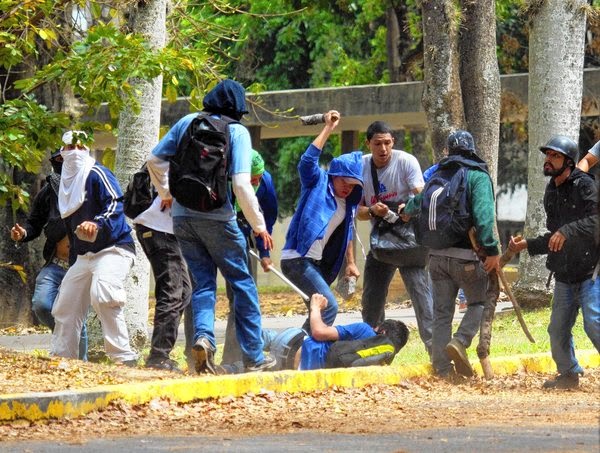
Photo: Pro-government assailants beat a student at the Central University of Venezuela on Thursday. Via Los Angeles Times.

Although there are several news to review this week about Venezuela two themes are key as they are two of the most important reasons why people have been protesting for the past two months: violence and scarcity. It almost goes without saying that these evident violations of Human Rights you will see below, keep being ignored by the government and most of the international community, specially the Latin American one.


1. On violence: On Thursday while the Bolivarian National Guard (GNB) of Venezuela prevented students from exiting the premises of the Central University of Venezuela (UCV), pro-government and opposition students clashed, and shortly after the attack of armed pro-government 'colectivos' to students started. "Victor Marquez, president of the faculty association at the Central University of Venezuela in Caracas, said the attack Thursday on a group of about 1,200 students was carried out by men armed with metal pipes and wooden rods as national guard members stood by. Witnesses said the assailants also had pistols, but no shots were fired . . . Marquez said the campus had been invaded by motorcycle-riding vigilantes at least 10 times since student-led protests began sweeping the country in early February. The university, which was founded in 1721, has become a rallying point for students and others to protest Venezuela's high crime rate, food shortages and struggling economy." Read full article in Los Angeles Times.

Here is a video via BBC that shows how the 'colectivos' stripped naked and beat one of the students. And here is another photo via AP in Yahoo News. And you can also see some photos in The Daily Mail (is The Daily Mail, I know, but the photos are okay.)

One good news in this front is that Spain (finally) decided to stop selling anti-riot equipment to Venezuela (link in Spanish) due to the violence that from the beginning of February had left 39 people dead, 550 injured and more than 2000 arrests, according to Amnesty International figures.


2. On scarcity: It is important to point out that Venezuela, the country with the largest reserves of oil of the entire planet, that is been benefiting from an abundant and steady flow of cash in the past 15 years (mostly coming from oil sales to our number 1 "enemy" the US), there is no food. And this is not the result of an economic war, as the government desperately try to make everyone believe; this is the consequence of an incredible corrupt exchange control system, of the expropriation and consequently poor management of companies, and of the several pacts made with other countries of the region: food and convenient silence in exchange for cheap oil.

Anyway, the video that El Nacional publishes (link in Spanish), shows how the Venezuelan military now checks the trolleys in the supermarkets so people don't buy more than their assigned quota of food. In the entrance of the Bicentenario Supermarket of Plaza Venezuela (Caracas center) a sign warns: 2 L of cooking oil, 2 and a half packs of coffee, 2 Kg of Milk, 2 Kg of Wheat flour, and 4 Kg of Corn flour per person.

In a related subject The Economist publish an article that explains Venezuela's "bizantine foreign exchange apparatus". The article opens with an incredibly accurate paragraph, hard to find in international media: "HOW many bolívares does it take to buy a US dollar? That question, which in a normal economy would get an over-the-counter answer, has everyone scratching their heads in Venezuela. It depends, they might say, on what you want it for. Or how well connected you are. Or even on the day of the week." It sounds crazy, but its true, and it's been true since the exchange control was implemented. The article goes on explaining the impact of this system in the economy of the country: "In an economy that exports little but petroleum and refined products, and imports just about everything else (including most food), the exchange rate is a crucial factor in domestic prices. Many of these are set by the government, in a rather futile bid to control inflation, which last year stood at over 56%. The result of these controls has been ever-increasing scarcity. The central bank’s monthly scarcity index hit 28% in January, meaning more than one in four of the goods it tracks was missing from the shelves. Nelson Merentes, the bank’s governor, says the index will no longer be published since it has become “political”, a euphemism for “too damaging to release”. Read full article in The Economist.

Links en Español:

BBC Mundo: El desnudo político que impacta a Venezuela.  Entre las ya comunes escenas de la violencia que se producen en Venezuela desde hace casi dos meses, este jueves una imagen captó la atención mundial: la de un joven siendo desnudado por un grupo rival dentro de la Universidad Central de Venezuela (UCV). En videos y fotografías se captó el momento en el que el joven no identificado es rodeado por un grupo de encapuchados hostiles que lo zarandean, lo golpean en el piso y tras quitarle la ropa le obligan a abandonar el lugar. Es el episodio que más ha destacado de los violentos enfrentamientos que se produjeron dentro de la UCV entre estudiantes afiliados a la oposición y grupos de supuestos simpatizantes del gobierno, llamados "colectivos".

Últimas Noticias: Así atacaron grupos armados dentro de la UCV. Este jueves un grupo de personas armadas (algunas identificadas con ropa del oficialismo) atacaron a estudiantes de la Universidad Central de Venezuela, algunos de los jóvenes fueron desnudados y golpeados; además despojaron de sus equipos a cuatro reporteros gráficos de medios privados.

El Nacional: Milicias inspeccionan carritos de compras. En el gran abasto Bicentenario de Plaza Venezuela los milicianos son los encargados de chequear que los consumidores no se lleven más productos regulados de los que se permiten por persona. En la entrada un aviso alerta: 2 litros de aceite, 2 paquetes de medio kilo de café, 2 kilos de leche, 2 kilos de harina de trigo y 4 kilos de harina de maíz por person.

El País: España suspende la venta de material antidisturbios a Venezuela. El Gobierno español ha suspendido cautelarmente y por tiempo indefinido la exportación de material antidisturbios a Venezuela, ante la espiral de violencia que vive dicho país desde principios de febrero y que ha dejado un saldo de 39 muertos, 550 heridos y más de 2.000 detenidos, según datos de Amnistía Internacional. La decisión fue adoptada por la Junta Interministerial Reguladora del Comercio Exterior de Material de Defensa y Doble Uso (JIMDDU) –en la que están representados los departamentos de Asuntos Exteriores, Defensa, Interior, Comercio o Hacienda– el pasado 6 de marzo, pero no se ha hecho pública.